
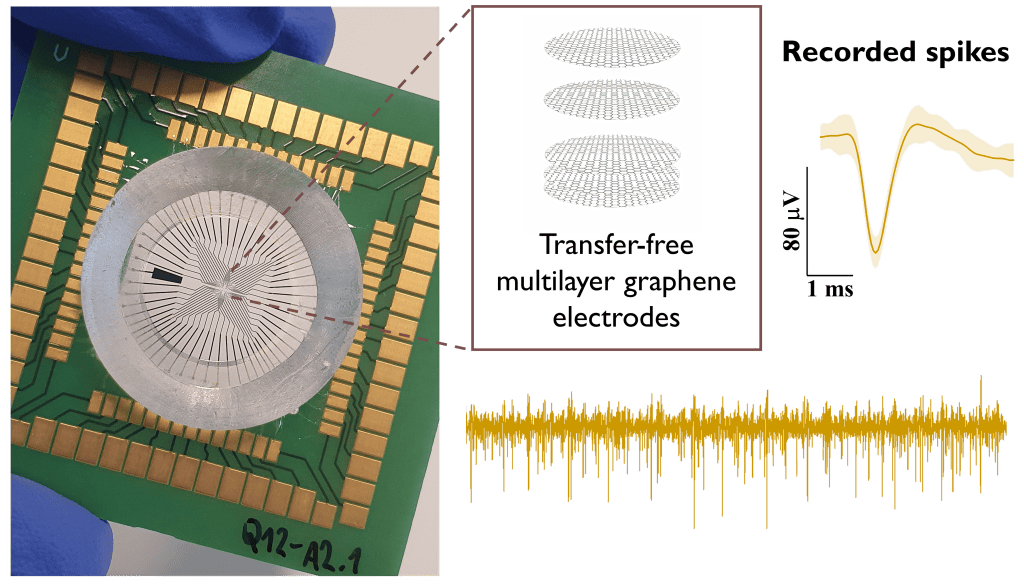
New paper out! Nerea Alvarez de Eulate did a wonderful work developing optically transparent multilayer graphene electrodes, miniaturizing them down to 10 µm, and using them to record brain activity in vitro.
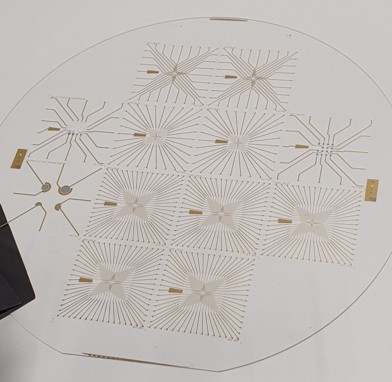
In this work, we present multilayer graphene microelectrodes fabricated directly on transparent wafer substrates, eliminating the need for transferring pre-grown layers. Beyond this, the key contribution lies in the fundamental demonstration: to the best of our knowledge, this is the first study to report neural recordings using transparent graphene electrodes with diameters as small as 10 µm.
Our results challenge the prevailing focus on achieving ultra-low electrode impedance as the primary requirement for high-quality neural recordings. While impedance plays an important role, it should be considered alongside other critical factors, including neuron–electrode coupling and the intrinsic properties of the recording electronics.
This was an invited contribution to the special issue “Precision Brain Interfacing”
Cite this paper: N. Alvarez de Eulate, C. Pavlou, G. León González, L. Holzapfel, Z. Gao, S. Vollebregt, and V. Giagka, “Transparent transfer-free ultrasmall multilayer graphene microelectrodes enable high quality recordings in brain slices,” Advanced Science, e17524, Jan. 2026. doi: 10.1002/advs.202517524.

