SoMa @ GRS/GRC Neuroelectronic Interfaces 2026

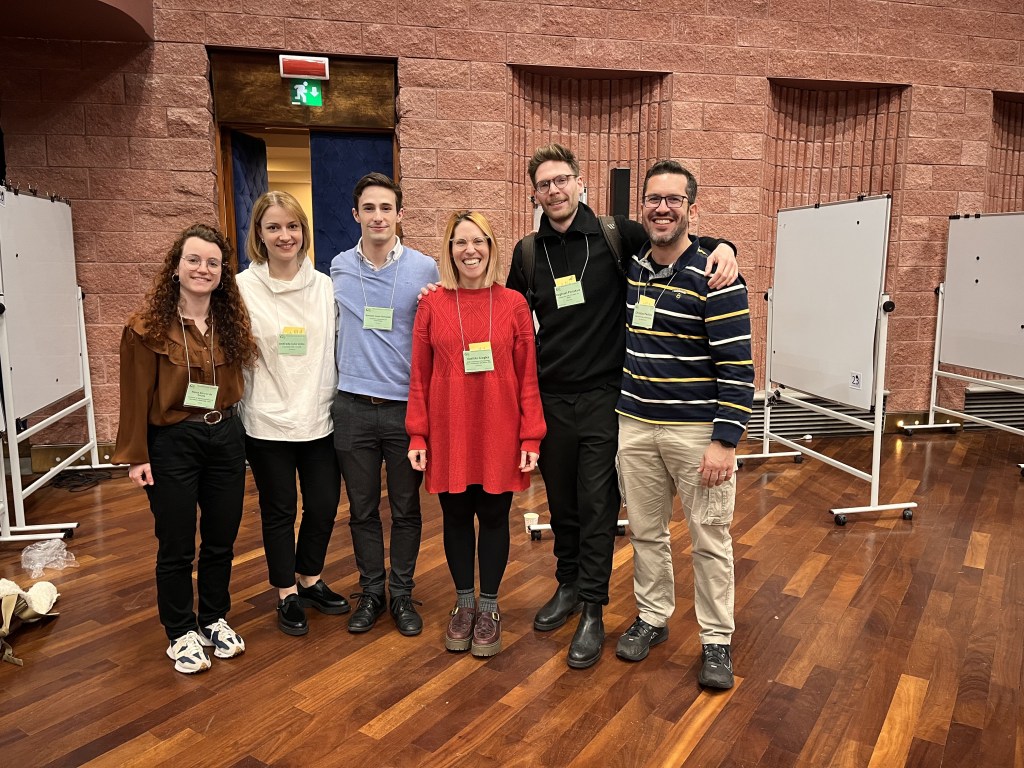
The SoMa Lab participated this year at the Gordon Research Seminar and Gordon Research Conference on Neuroelectronic Interfaces.
During GRS, Andrada Iulia Velea gave an oral presentation on the topic of Bimodal Neural Interfaces: Material Insights for the Seamless Operation across Electrical and Acoustic Domains.

Our PI, Vasiliki Giagka, joined a panel to discuss “Navigating the Neurotech Landscape: Research, Entrepreneurship, Industry, and Career Opportunities” alongside Prof. Thomas Stieglitz, Prof. George Malliaras, and Prof. Maria Asplund.

During GRC, Raphael Panskus and Dr. Christos Pavlou presented their posters on Ultrasound-transparent neural interfaces for multimodal interaction and Transparent Graphene Microelectrode Arrays for Ex Vivo and Implantable Neural Interfaces, respectively.

Former SoMa members Nerea Alvarez de Eulate Llano (currently @ IMB-CNM, CSIC, PIs: Dr. Anton Guimerà and Prof. Jose Garrido) and Gonzalo Léon González (currently @Chalmers, PI: Prof. Maria Asplund), who are now pursuing their PhDs, were also attending, so it felt like a small reunion!

The conference took place in beautiful Tuscany, Italy and it was a great moment of getting together with colleagues and friends from around the world to discuss science and engineering!

GRC is definitely one of our favourites, we will be coming back!
Transparent transfer-free ultrasmall multilayer graphene microelectrodes enable high quality recordings in brain slices

New paper out! Nerea Alvarez de Eulate did a wonderful work developing optically transparent multilayer graphene electrodes, miniaturizing them down to 10 µm, and using them to record brain activity in vitro.

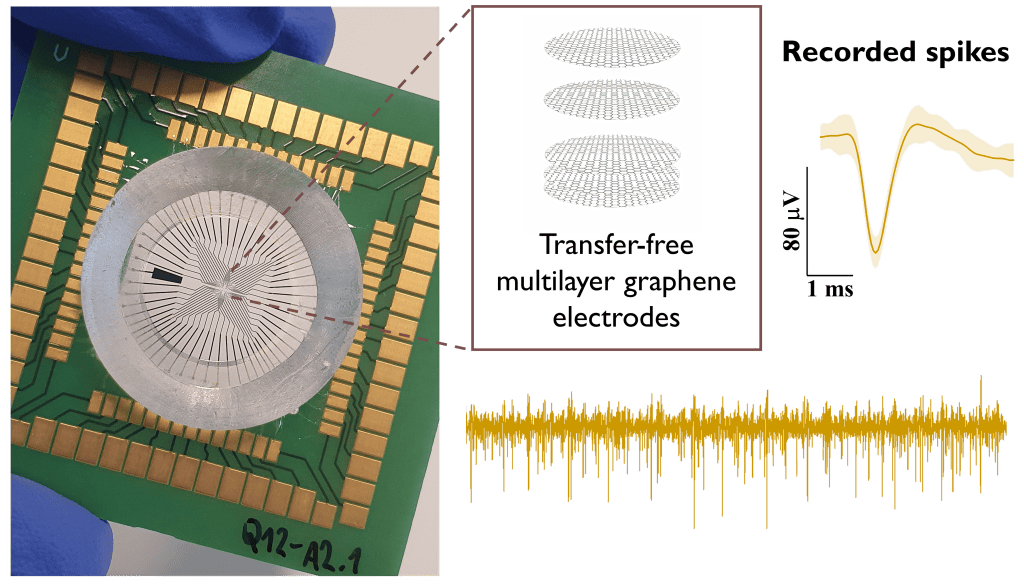
In this work, we present multilayer graphene microelectrodes fabricated directly on transparent wafer substrates, eliminating the need for transferring pre-grown layers. Beyond this, the key contribution lies in the fundamental demonstration: to the best of our knowledge, this is the first study to report neural recordings using transparent graphene electrodes with diameters as small as 10 µm.

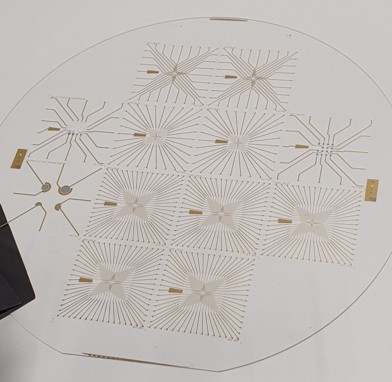
An optically transparent wafer containing various MicroElectrode Array designs with transfer-free multilayer graphene.

Our results challenge the prevailing focus on achieving ultra-low electrode impedance as the primary requirement for high-quality neural recordings. While impedance plays an important role, it should be considered alongside other critical factors, including neuron–electrode coupling and the intrinsic properties of the recording electronics.

A Micro Electrode Array with 10 μm-small electrodes made of transfer-free multilayer graphene can record clean spikes from the brain ex vivo.

This was an invited contribution to the special issue “Precision Brain Interfacing”

Cite this paper: N. Alvarez de Eulate, C. Pavlou, G. León González, L. Holzapfel, Z. Gao, S. Vollebregt, and V. Giagka, “Transparent transfer-free ultrasmall multilayer graphene microelectrodes enable high quality recordings in brain slices,” Advanced Science, e17524, Jan. 2026. doi: 10.1002/advs.202517524.

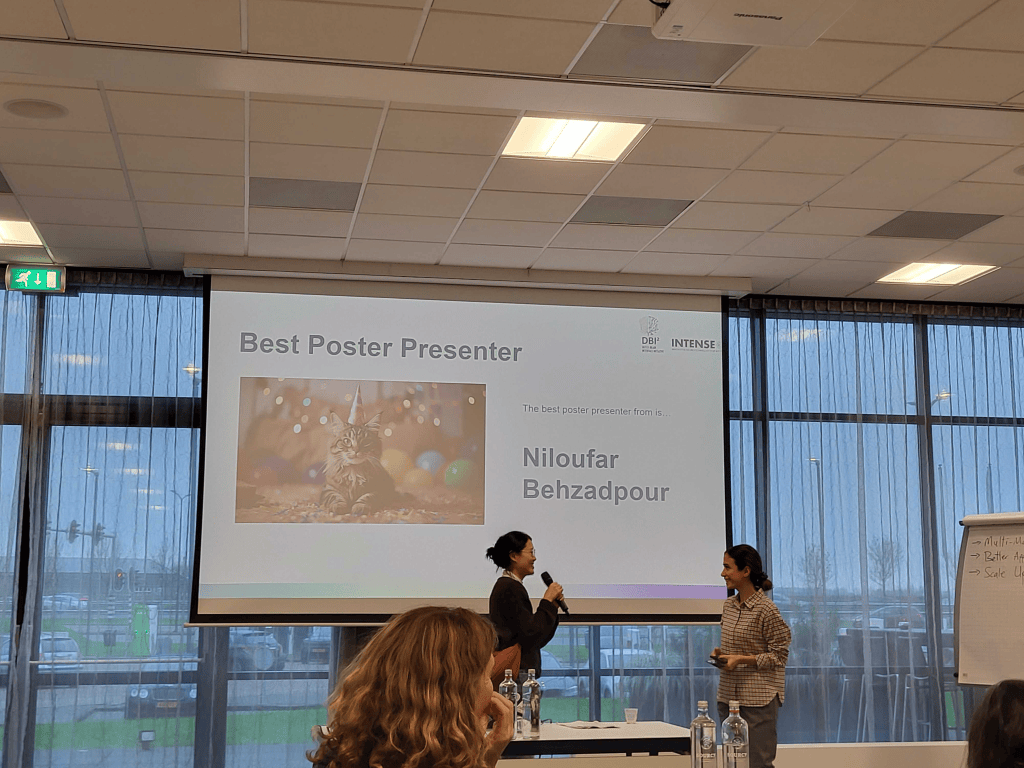
Best poster presenter award for Niloufar Behzadpour during the INTENSE and DBI2 joint retreat

In November 2025, the DBI2 consortium organised a joint retreat together with the INTENSE project and the SoMa Lab was present!

Vasiliki Giagka gave a Keynote talk during the INTENSE project retreat on the topic of Conformal Neural Interfaces for Chronic Applications, and Niloufar Behzadpour won the best poster presenter award! Congratulations, Niloufar!

Over three days, participants reflected on the major scientific milestones of the DBI2 and INTENSE. The programme included a dedicated career development session for early‑career researchers. Two thought‑provoking panel discussions focused on Lessons Learned from INTENSE to DBI2 and Generative AI for Science and Society.

The retreat concluded with cross‑theme discussions that helped shape DBI2’s future research directions.

Find out more about our DBI2 project here: https://dbi2.nl

Wirelessly powered neural stimulators can be more efficient

Typical block level diagram of neural stimulators

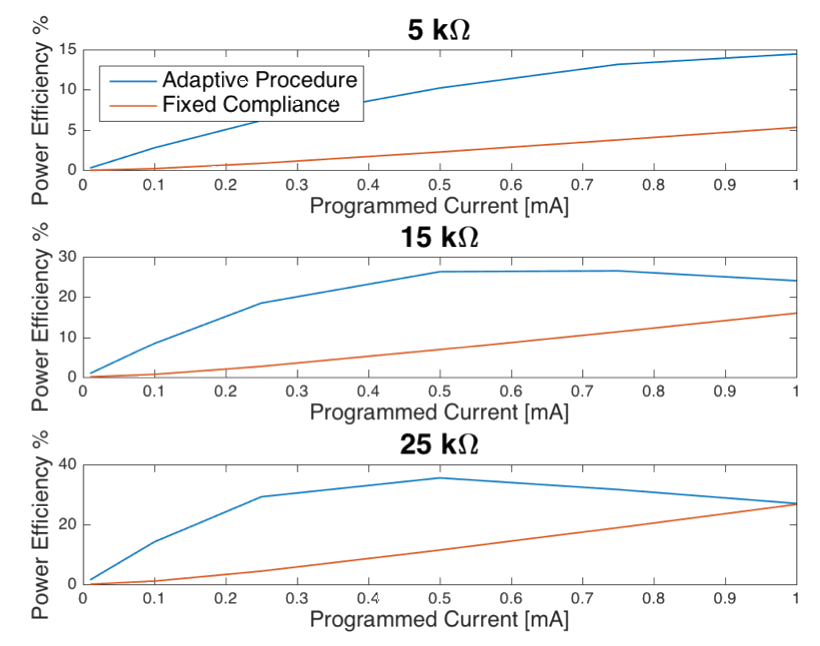
Wirelessly powered neural stimulators can be more efficient than the state of the art. This can be achieved by making the supply of the commonly used constant current source adaptive based on what is really needed at the output, leading to a power efficiency increase of up to 35%, compared to a fixed supply.

Here we have created the first discrete component neurostimulator with adaptive supply.

Typically, neural stimulators feature a high voltage supply, used to accommodate for changes at the output impedance. However, this means that when we need to drive low impedances or with low currents, there is an unnecessary voltage drop at the output, which leads to lower efficiencies. We can sense what is the real required output voltage and based on that adjust the power supply, thus creating a more efficient system, avoiding unnecessary losses.

Main characteristics of this system:
  • Small, cheap, discrete component implementation
  • Accuracy (>96%) and speed
  • Adaptive supply (6-28 V)
  • Power efficiency increase up to 35.5% compared to fixed supply
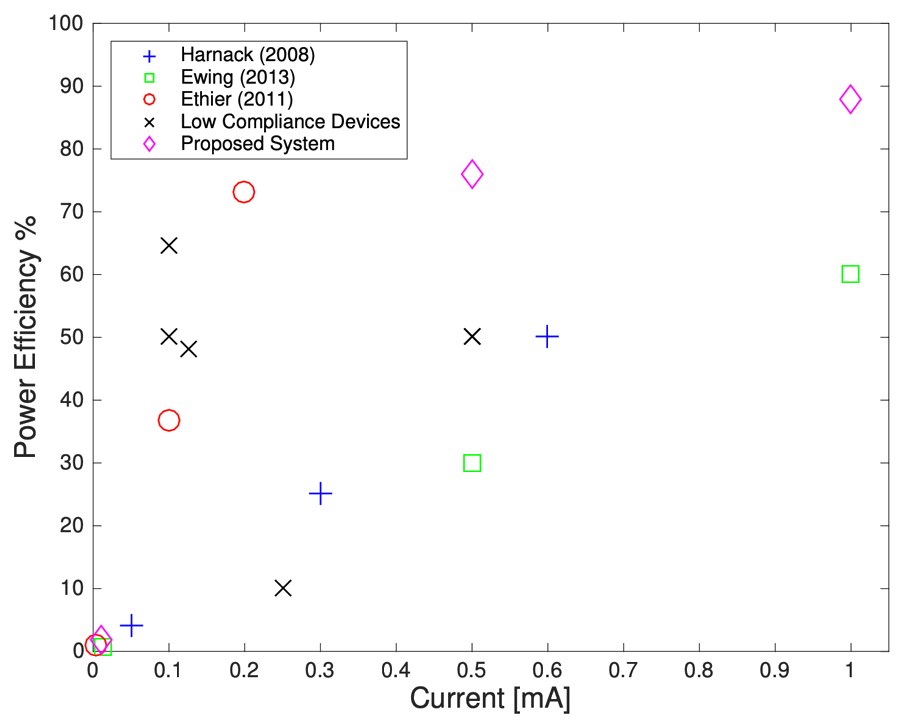
Power efficiency comparison of reported current controlled stimulators and our proposed system
Power efficiency of the proposed adaptive supply system compared to a fixed one


Cite this paper: G. E. Ólafsdóttir, W. A. Serdijn, and V. Giagka, “An energy-efficient, inexpensive, spinal cord stimulator with adaptive voltage compliance for freely moving rats,” in Proc. 40th Int. Conf. of the IEEE Engineering in Medicine and Biology (EMBC) 2018, Honolulu, Hawaii, USA, Jul. 2018, pp. 2937 – 40.