
Our latest paper, “On the longevity and inherent hermeticity of silicon-ICs: evaluation of bare-die and PDMS-coated ICs after accelerated aging and implantation studies,” is now published in Nature Communications Portfolio.
Silicon integrated circuits (ICs) are at the heart of next-generation brain-computer interfaces BCIs and active neural implants. A key question driving our work: How do we ensure these tiny, powerful chips remain reliable in the body’s corrosive environment for decades?
In our study, we evaluated the inherent hermeticity of CMOS ICs and explored PDMS as a lightweight, accessible encapsulation material to enhance their longevity in vivo.
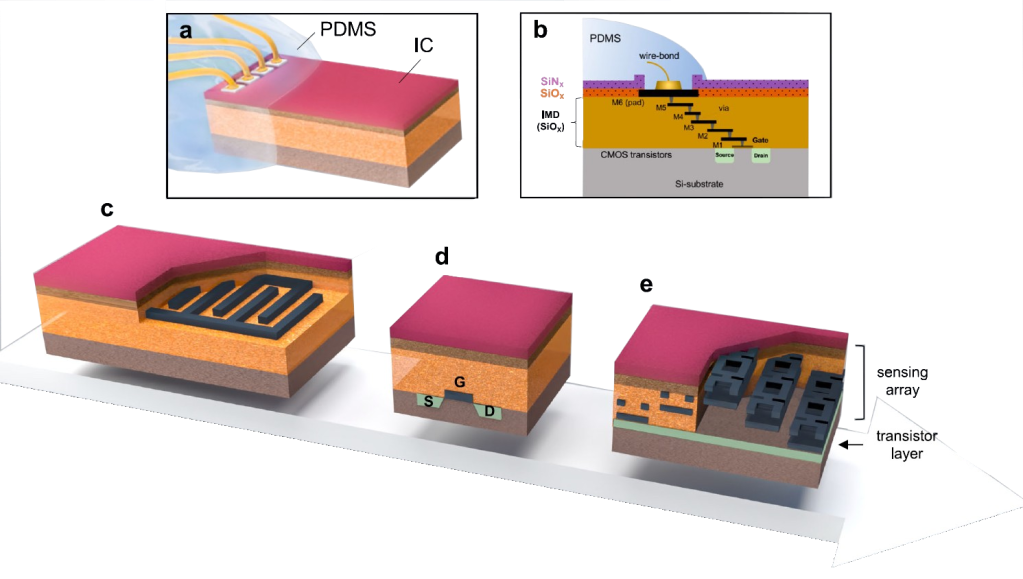
Key findings:
- Foundry-fabricated CMOS exhibit inherent hermeticity, and can maintain their functionality in the body for at least 12 months unprotected. However, the outer nitride layers gradually degrade over time.
- PDMS encapsulation acts as a soft moisture-permeable coating, preventing nitride dissolution, inhibiting ion ingress, and extending implantable IC lifetimes to decades.
- Accelerated aging models in PBS alone are insufficient for bare die ICs but remain valid for PDMS-encapsulated chips, thanks to the material’s protective properties.
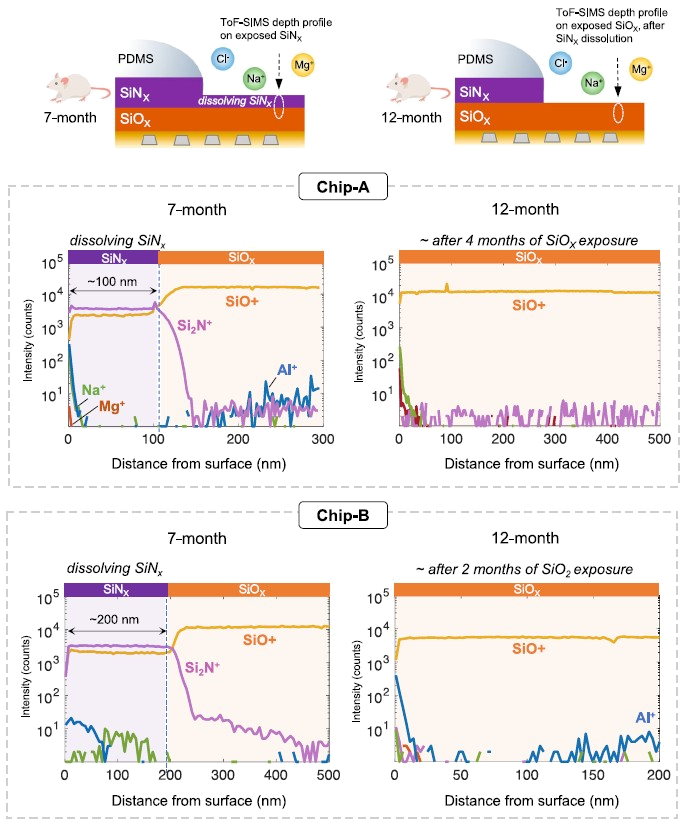
This publication represents 4+ years of interdisciplinary effort, including in vitro and in vivo studies, to bring CMOS technology closer to its full potential in bioelectronics. There is a wealth of information in the paper, including guidelines for designing state-of-the-art polymer-packaged neurotechnologies.
We believe these findings will contribute to advancing the clinical relevance of neurotechnologies, paving the way for minimally invasive, reliable brain-machine interfaces and active neuroelectronic implants.
Cite this paper: K. Nanbakhsh, A. Shah Idil, C. Lamont, C. Dusco, O. C. Akgun, D. Horvath, K. Toth, D. Meszena, I. Ulbert, F. Mazza, T. G. Constandinou, W. A. Serdijn, A. Vanhoestenberghe, N. Donaldson, and V. Giagka, “On the Longevity and Inherent Hermeticity of Silicon-ICs: Evaluation of Bare-Die and PDMS-Coated ICs After Accelerated Aging and Implantation Studies,” Nat. Commun., vol. 16, no. 12, Jan. 2025. doi: 10.1038/s41467-024-55298-4.
 SoMa Lab