
Ultrasound is a powerful modality for wireless powering of implantable devices. But packaging remains a major challenge: hermetic cases often block acoustic transmission, while soft polymer encapsulation may alter device performance.
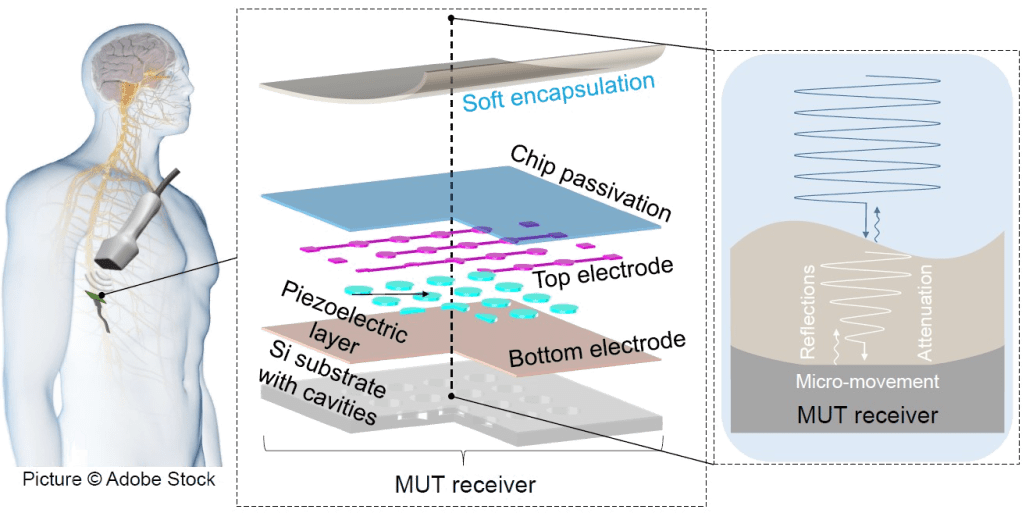
In our recent work at IEEE Transactions on Ultrasonics, Ferroelectrics, and Frequency Control (UFFC), we investigated how implant-grade polymer coatings such as thermoplastic polyurethane, parylene-C, and medical-grade silicones affect the receive performance of piezoelectric micromachined ultrasonic transducers (PMUTs).
Key findings:
- All tested coatings were highly acoustically transparent (>94% transmission).
- But performance depends not only on acoustic transparency, but also on mechanical effects: stiffness, residual stress and fleixural rigidity of the coating.
- Softer materials (e.g. silicones) preserve sensitivty even at larger thicknesses.
- Stiffer coatings (e.g., parylene-C) can reduce sensitivity, unless applied in very thin layers.

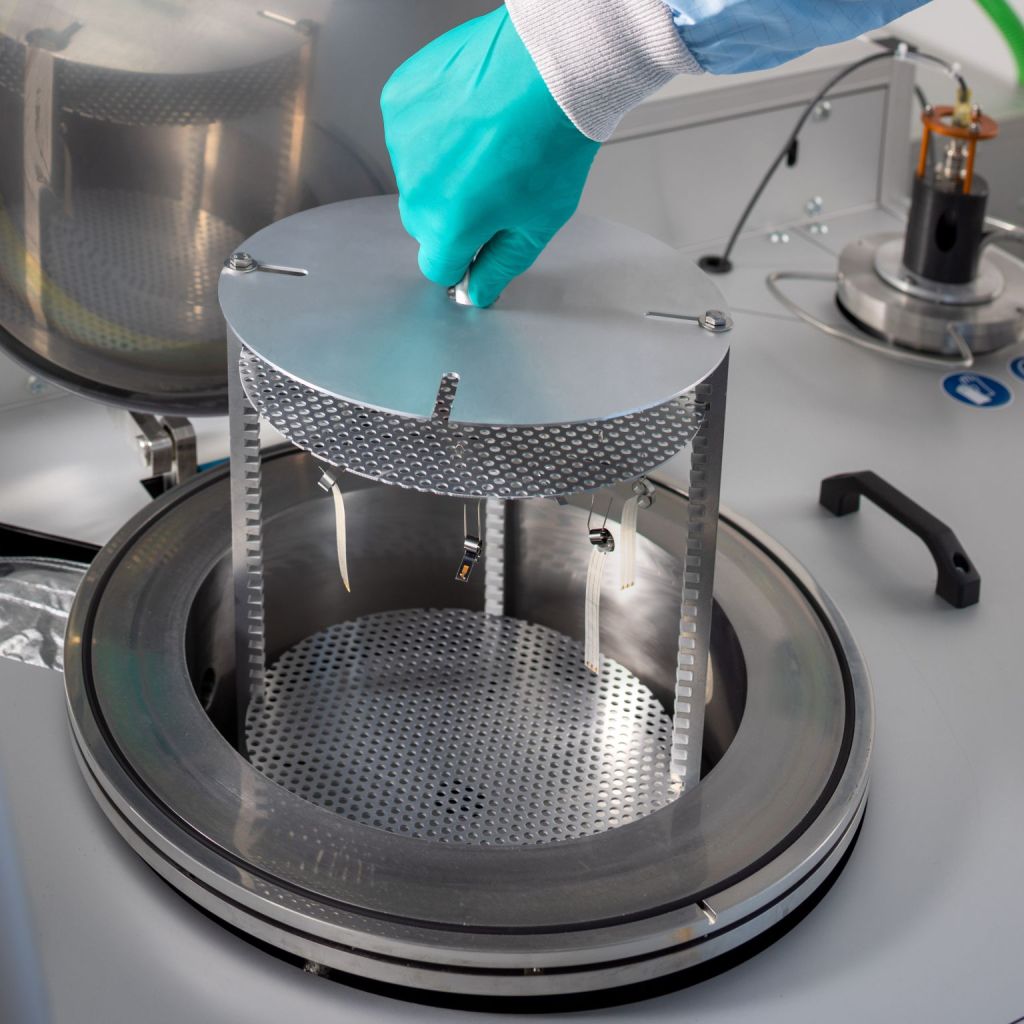
of the encapsulation processes.
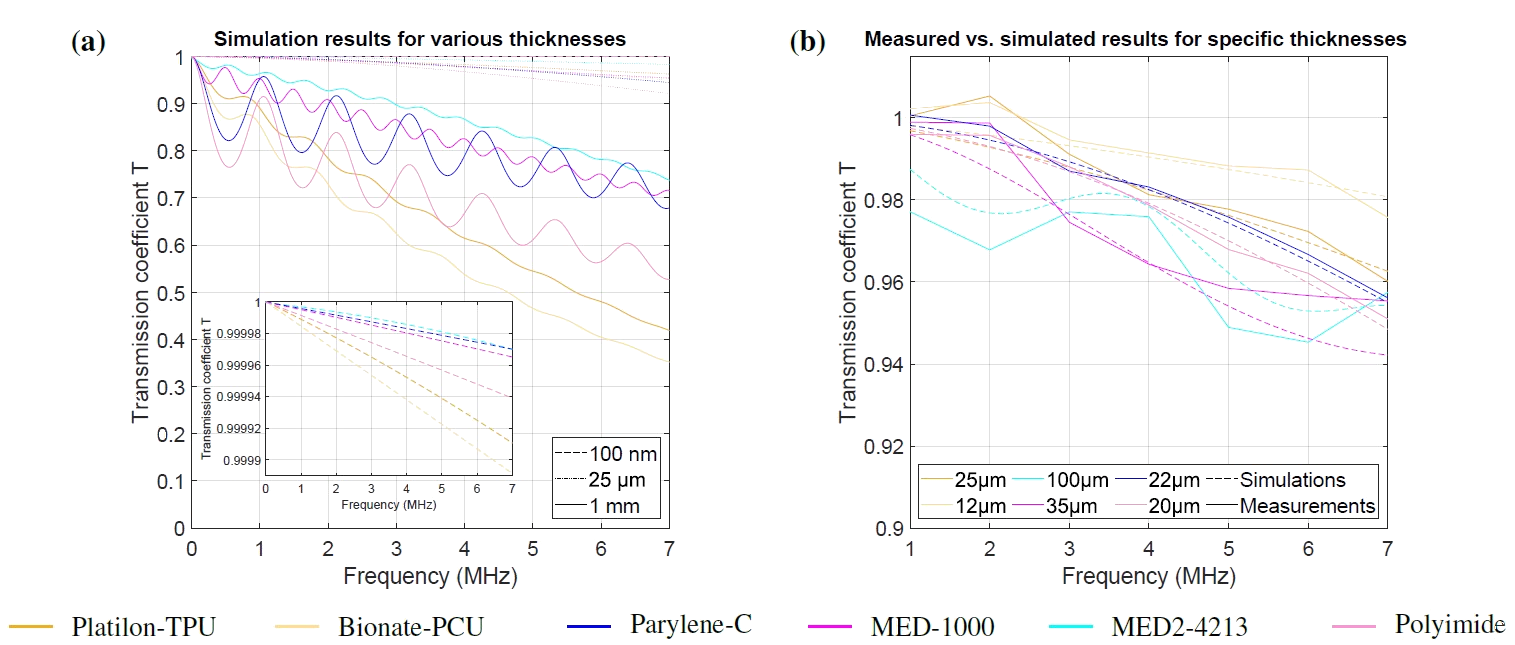
(b) Measured transmission coefficients juxtaposed against simulations.
Our results provide a framework for selecting encapsulation strategies that balance long-term stability and ultrasonic performance, enabling more reliable and miniaturized implantable devices.
Cite this paper: A. I. Velea, R. Panskus, B. Szabo, V. A. -L. Oppelt, L. Holzapfel, C. B. Karuthedath, A. T. Sebastian, T. Stieglitz, A. S. Savoia, and V. Giagka, “Effects of Soft Encapsulation on the Receive Performance of PMUTs for Implantable Devices,” IEEE Trans. Ultrasonics, Ferroelectrics, and Frequency Control (UFFC), vol. 72, no. 9, pp. 1282-1292, Sept. 2025, doi: 10.1109/TUFFC.2025.3592740.




 SoMa Lab