Ultrasound-transparent neural interfaces for multimodal interaction

We are very excited to share our latest publication on the topic of Ultrasound transparent neural interfaces for multimodal interaction, recently published in Nature Portfolio npj Flexible Electronics in collaboration with the groups of David Maresca and Valeria Gazzola.

Schematic illustration of the concept of ultrasound-compatible neural electrodes. (1) Importance of multimodal sensing and stimulation, (2) Challenges of ultrasound wave propagation,(3) Design method for ultrasound transparent neuralelectrodes
Structure and acoustic modeling ofpolymer-based electrodes.

Here, we introduce a framework for designing flexible, metal-based neural interfaces that remain acoustically transparent, enabling integration with functional and focused ultrasound technologies. We combine theory, simulations, and experiments to show how common implant materials and practical metal thicknesses can achieve high ultrasound transmission. Importantly, we demonstrate in vivo compatibility with functional ultrasound imaging (fUSI),
with undistorted signal transmission and robust visualization of subcortical activation through a neural interface. This work lays the foundation for multimodal neural interfaces that bridge electrophysiology, imaging and neuromodulation.
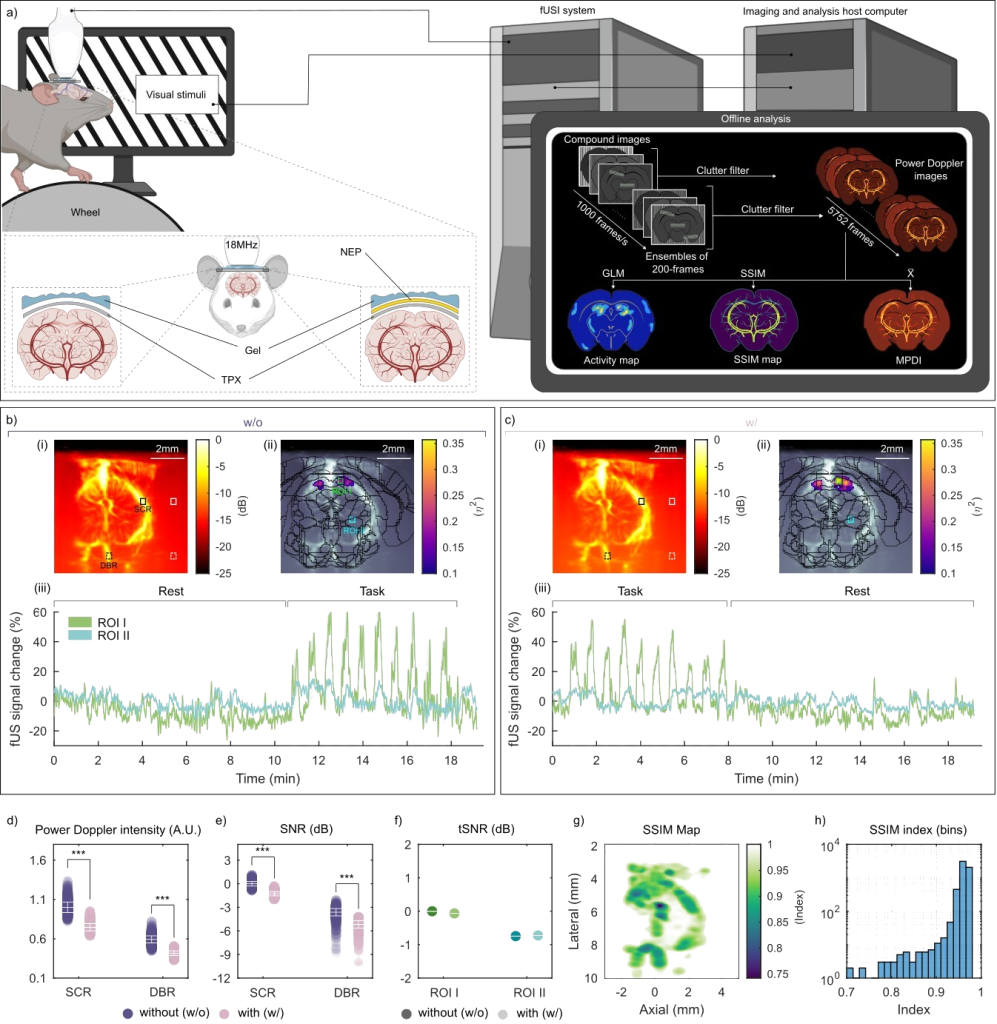
Functional ultrasound Doppler imaging of mice brain through a flexible neural interface.

A special shout-out goes to my talented PhD student, Raphael Panskus, who led this impressive work.

This was an invited contribution to the special collection “Conformable
Brain-Computer and Brain-Machine Interfaces” edited by Xinxia CaiJeffrey R Capadona,
Maria Asplund and Ulrich Hofmann.

Cite this paper: R. Panskus, A. I. Velea, L. Holzapfel, C. Pavlou, Q. Li, C. Qin, F. M. Nelissen, R. Waasdorp, D. Maresca, V. Gazzola, and V. Giagka, “Ultrasound Transparent Neural Interfaces for Multimodal Interaction,” npj Flexible Electronics, 2026. doi: 10.1038/s41528-025-00517-1.
Beyond Acoustic Transparency: The Role of Polymer Encapsulation

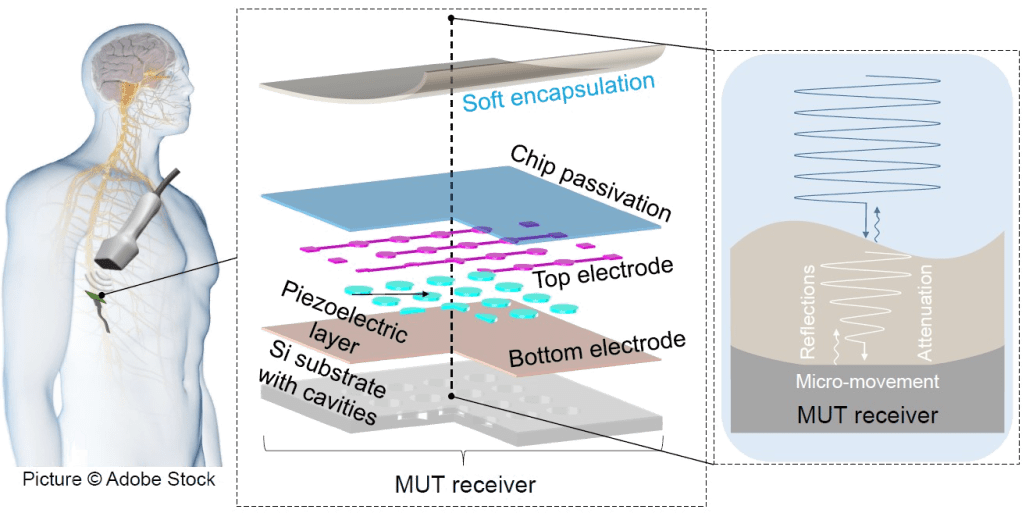
Ultrasound is a powerful modality for wireless powering of implantable devices. But packaging remains a major challenge: hermetic cases often block acoustic transmission, while soft polymer encapsulation may alter device performance.

Schematic illustration of the implantable MUT receiver and its layered structure

In our recent work at IEEE Transactions on Ultrasonics, Ferroelectrics, and Frequency Control (UFFC), we investigated how implant-grade polymer coatings such as thermoplastic polyurethane, parylene-C, and medical-grade silicones affect the receive performance of piezoelectric micromachined ultrasonic transducers (PMUTs).

Key findings:
  • All tested coatings were highly acoustically transparent (>94% transmission).
  • But performance depends not only on acoustic transparency, but also on mechanical effects: stiffness, residual stress and fleixural rigidity of the coating.
  • Softer materials (e.g. silicones) preserve sensitivty even at larger thicknesses.
  • Stiffer coatings (e.g., parylene-C) can reduce sensitivity, unless applied in very thin layers.
Test structures and encapsulation methods. (a) Top-view of the PMUT array layout. (b) Description
of the encapsulation processes.
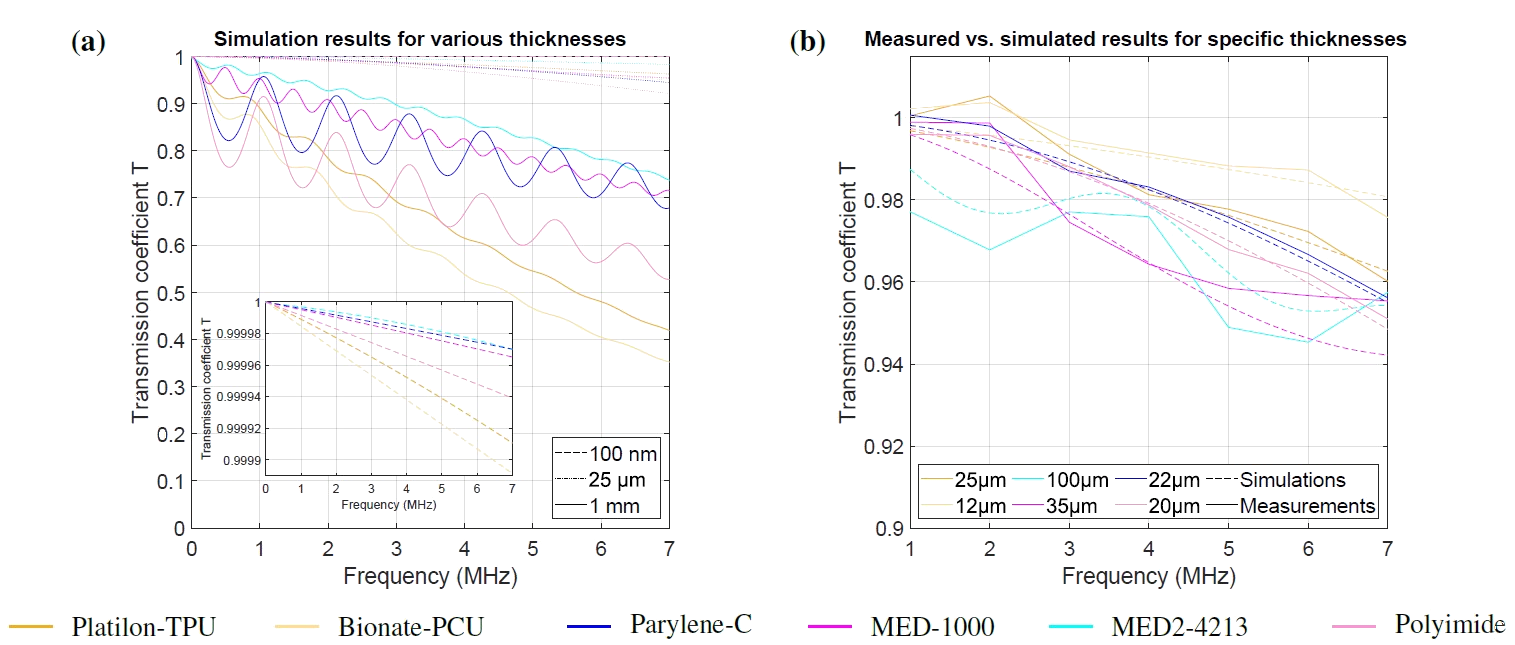
Acoustic characterisation of materials. (a) Simulated transmission coefficients through several polymer thicknesses
(b) Measured transmission coefficients juxtaposed against simulations.

Our results provide a framework for selecting encapsulation strategies that balance long-term stability and ultrasonic performance, enabling more reliable and miniaturized implantable devices.

Cite this paper: A. I. Velea, R. Panskus, B. Szabo, V. A. -L. Oppelt, L. Holzapfel, C. B. Karuthedath, A. T. Sebastian, T. Stieglitz, A. S. Savoia, and V. Giagka, “Effects of Soft Encapsulation on the Receive Performance of PMUTs for Implantable Devices,” IEEE Trans. Ultrasonics, Ferroelectrics, and Frequency Control (UFFC), vol. 72, no. 9, pp. 1282-1292, Sept. 2025, doi: 10.1109/TUFFC.2025.3592740.

How Soft Encapsulation Enables Long-Term Reliability of Silicon IC Implants

Our latest paper, “On the longevity and inherent hermeticity of silicon-ICs: evaluation of bare-die and PDMS-coated ICs after accelerated aging and implantation studies,” is now published in Nature Communications Portfolio.

Silicon integrated circuits (ICs) are at the heart of next-generation brain-computer interfaces BCIs and active neural implants. A key question driving our work: How do we ensure these tiny, powerful chips remain reliable in the body’s corrosive environment for decades?

In our study, we evaluated the inherent hermeticity of CMOS ICs and explored PDMS as a lightweight, accessible encapsulation material to enhance their longevity in vivo.

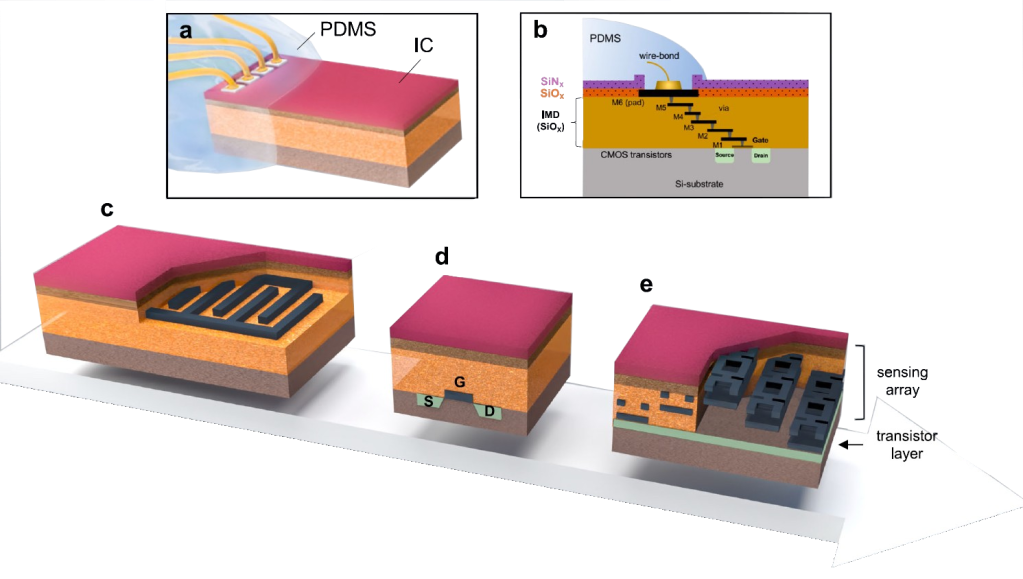
Schematic illustrations of silicon-IC test structures (dimensions not to scale). (a) A wire-bonded IC partially coated with PDMS. (b) A cross-sectional schematic demonstrating the multilayer stack of a representative 6-metal CMOS process. (c-e) Schematic of implemented test structures in silicion-IC, from simple to more advanced.
Key findings:
  • Foundry-fabricated CMOS exhibit inherent hermeticity, and can maintain their functionality in the body for at least 12 months unprotected. However, the outer nitride layers gradually degrade over time.
  • PDMS encapsulation acts as a soft moisture-permeable coating, preventing nitride dissolution, inhibiting ion ingress, and extending implantable IC lifetimes to decades.
  • Accelerated aging models in PBS alone are insufficient for bare die ICs but remain valid for PDMS-encapsulated chips, thanks to the material’s protective properties.
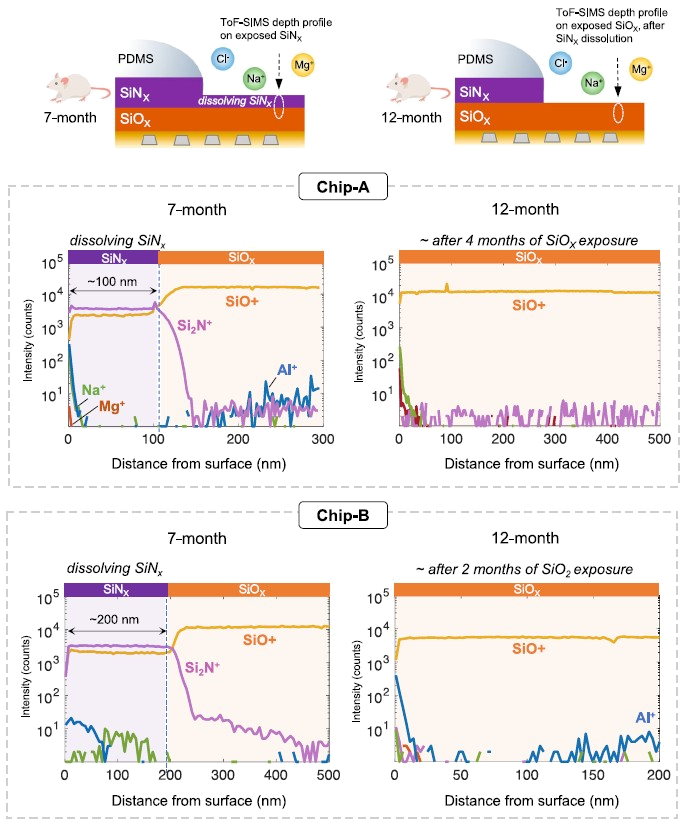
Positive mode ToF-SIMS depth profiles analyzing the ionic barrier performance of the exposed passivation layers after 7 and 12 months implantation in rat.

This publication represents 4+ years of interdisciplinary effort, including in vitro and in vivo studies, to bring CMOS technology closer to its full potential in bioelectronics. There is a wealth of information in the paper, including guidelines for designing state-of-the-art polymer-packaged neurotechnologies.

We believe these findings will contribute to advancing the clinical relevance of neurotechnologies, paving the way for minimally invasive, reliable brain-machine interfaces and active neuroelectronic implants.

Cite this paper: K. Nanbakhsh, A. Shah Idil, C. Lamont, C. Dusco, O. C. Akgun, D. Horvath, K. Toth, D. Meszena, I. Ulbert, F. Mazza, T. G. Constandinou, W. A. Serdijn, A. Vanhoestenberghe, N. Donaldson, and V. Giagka, “On the Longevity and Inherent Hermeticity of Silicon-ICs: Evaluation of Bare-Die and PDMS-Coated ICs After Accelerated Aging and Implantation Studies,” Nat. Commun., vol. 16, no. 12, Jan. 2025. doi: 10.1038/s41467-024-55298-4.

Wirelessly powered neural stimulators can be more efficient

Typical block level diagram of neural stimulators

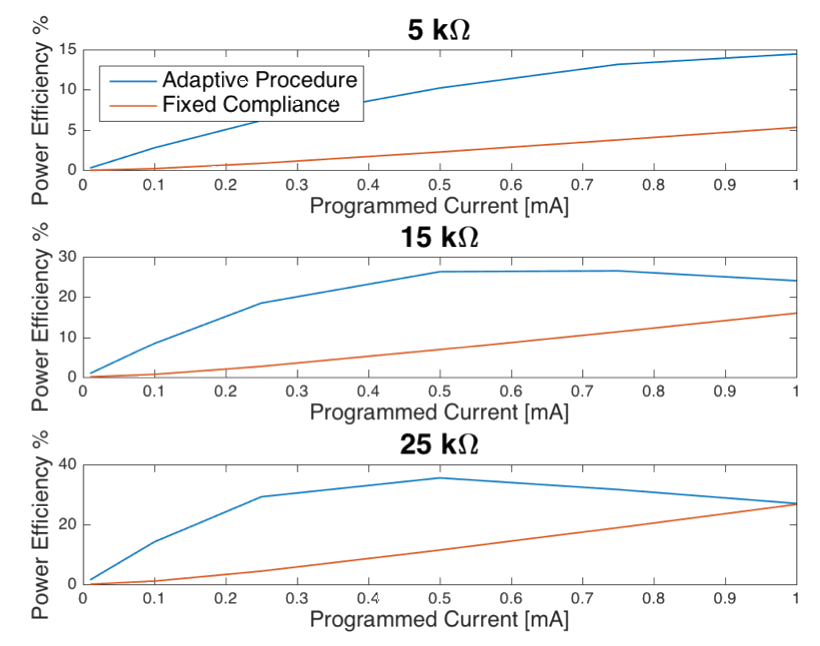
Wirelessly powered neural stimulators can be more efficient than the state of the art. This can be achieved by making the supply of the commonly used constant current source adaptive based on what is really needed at the output, leading to a power efficiency increase of up to 35%, compared to a fixed supply.

Here we have created the first discrete component neurostimulator with adaptive supply.

Typically, neural stimulators feature a high voltage supply, used to accommodate for changes at the output impedance. However, this means that when we need to drive low impedances or with low currents, there is an unnecessary voltage drop at the output, which leads to lower efficiencies. We can sense what is the real required output voltage and based on that adjust the power supply, thus creating a more efficient system, avoiding unnecessary losses.

Main characteristics of this system:
  • Small, cheap, discrete component implementation
  • Accuracy (>96%) and speed
  • Adaptive supply (6-28 V)
  • Power efficiency increase up to 35.5% compared to fixed supply
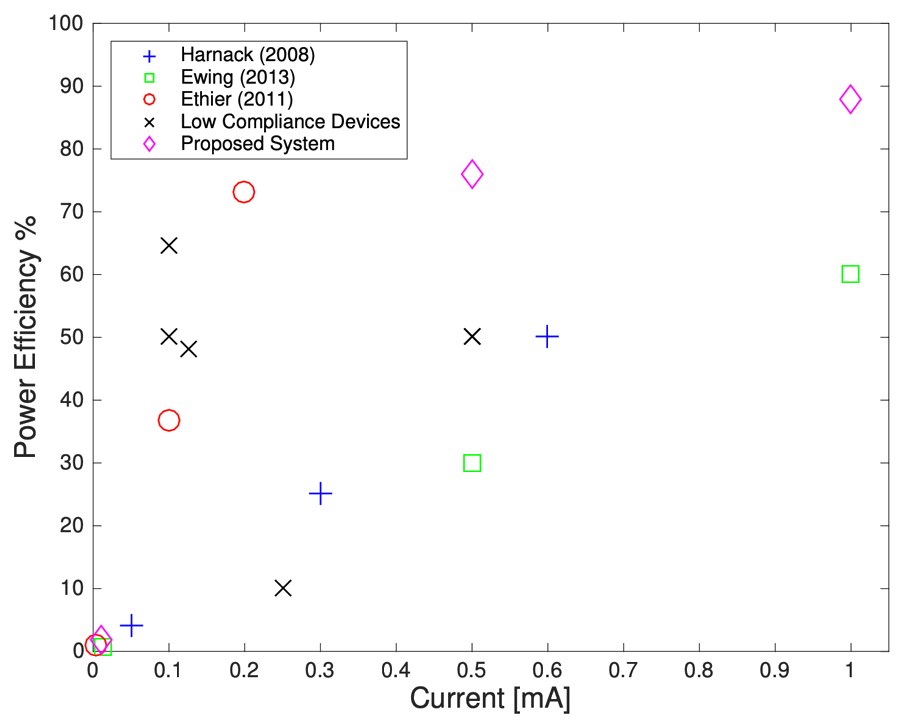
Power efficiency comparison of reported current controlled stimulators and our proposed system
Power efficiency of the proposed adaptive supply system compared to a fixed one


Cite this paper: G. E. Ólafsdóttir, W. A. Serdijn, and V. Giagka, “An energy-efficient, inexpensive, spinal cord stimulator with adaptive voltage compliance for freely moving rats,” in Proc. 40th Int. Conf. of the IEEE Engineering in Medicine and Biology (EMBC) 2018, Honolulu, Hawaii, USA, Jul. 2018, pp. 2937 – 40.