

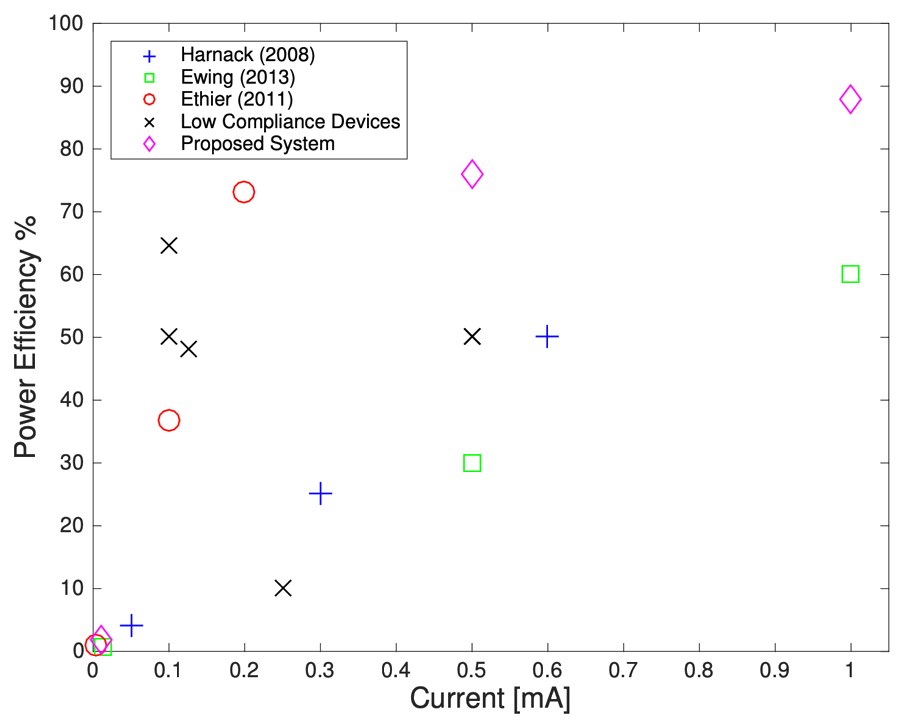
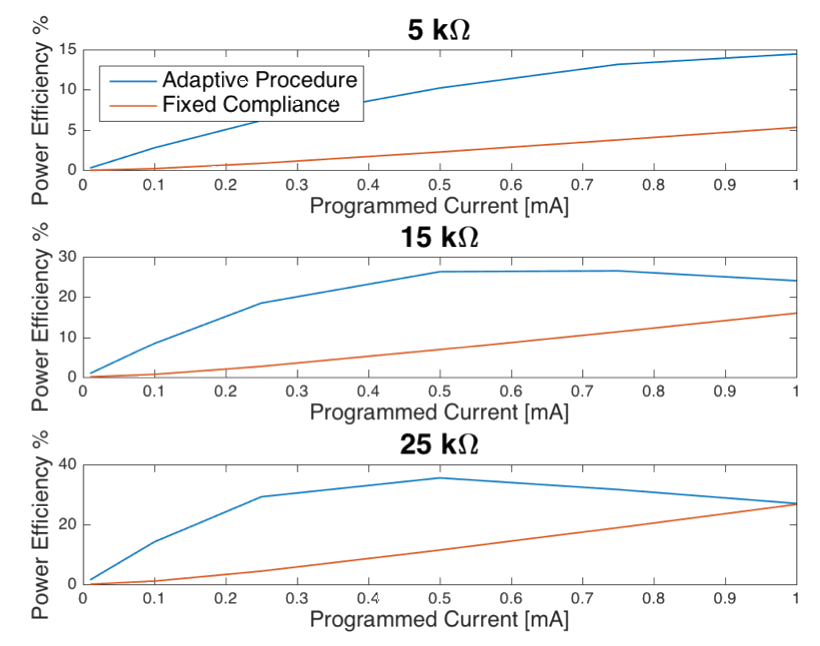
Wirelessly powered neural stimulators can be more efficient than the state of the art. This can be achieved by making the supply of the commonly used constant current source adaptive based on what is really needed at the output, leading to a power efficiency increase of up to 35%, compared to a fixed supply.
Here we have created the first discrete component neurostimulator with adaptive supply.
Typically, neural stimulators feature a high voltage supply, used to accommodate for changes at the output impedance. However, this means that when we need to drive low impedances or with low currents, there is an unnecessary voltage drop at the output, which leads to lower efficiencies. We can sense what is the real required output voltage and based on that adjust the power supply, thus creating a more efficient system, avoiding unnecessary losses.
Main characteristics of this system:
- Small, cheap, discrete component implementation
- Accuracy (>96%) and speed
- Adaptive supply (6-28 V)
- Power efficiency increase up to 35.5% compared to fixed supply
Cite this paper: G. E. Ólafsdóttir, W. A. Serdijn, and V. Giagka, “An energy-efficient, inexpensive, spinal cord stimulator with adaptive voltage compliance for freely moving rats,” in Proc. 40th Int. Conf. of the IEEE Engineering in Medicine and Biology (EMBC) 2018, Honolulu, Hawaii, USA, Jul. 2018, pp. 2937 – 40.
 SoMa Lab
and this?